The Development of the German Air Force, 1919-1939 by Prof. Richard Suchenwirth
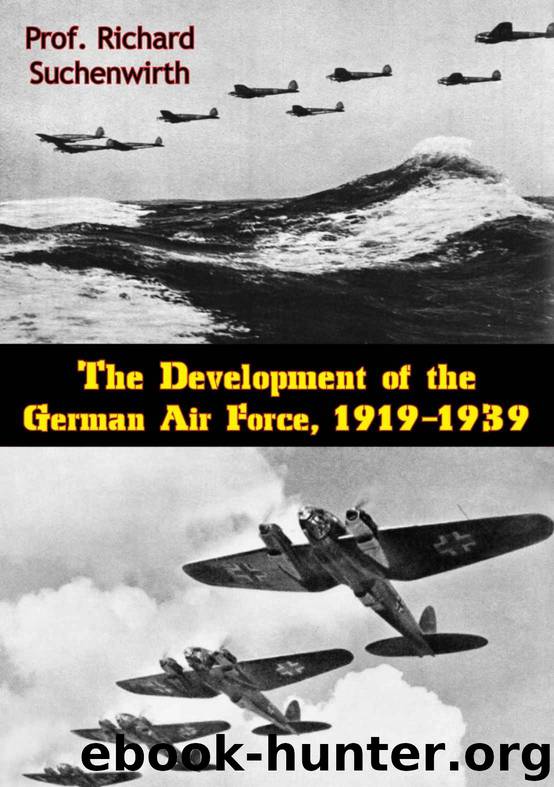
Author:Prof. Richard Suchenwirth [Suchenwirth, Prof. Richard]
Language: eng
Format: azw3
Publisher: Valmy Publishing
Published: 2017-06-28T04:00:00+00:00
Aeronautical Research in Germany{297}
The aftermath of World War I and the terrible inflationary period of the twenties would have meant the death-knell for German scientific research activity if industry had not stepped in with generous contributions through the auspices of the Emergency Organization for German Science, which was founded in 1920.{298} The projects supported by this organization were all the more in need of assistance since the German government was unable to provide adequate financial aid for its 2,600 university and college research institutes, for the extensive Reichs Institutes of Applied Physics and Applied Chemistry, or for the Kaiser-Wilhelm Institute with its thirty-seven subdivisions.
In the field of aviation there were the German Experimental Institute for Aviation in Berlin and the Experimental Institute of Aeronautics in Göttingen, but the German aviation industry believed that these two were insufficient to meet the needs of the time. Industry therefore took the initiative and established a research institute of its own, but, in so doing it made the mistake of failing to allot it sufficient funds. The result was a duplication of efforts in research and a lack of clearly delineated programs.
The Reichs Aviation Ministry was well aware of the inadequacies of this system and in 1933 authorized the founding of the Association for Aviation Research, an organization which was redesignated on 25 June 1936 as the Lilienthal Society for Aviation Research. Its objectives, apart from the establishment of aviation research goals, the promotion of specialized research projects, and the advancement of the exchange of scientific information, lay primarily in the area of applied technology. In addition, the Society endeavored to establish and maintain contact with the aviation industry, with commercial air agencies, and with the authorities concerned with the administration of civilian aviation activities, to disseminate information on the latest technological advances in aviation, and to promote the education of a new generation of flying enthusiasts. More ambitious research undertakings were handled by the German Academy of Aviation Research, a group which maintained contact with aviation and allied scientific agencies.
In 1937 the German Experimental Institute for Aviation and the Experimental Institute of Aeronautics were consolidated in the German Experimental Institute of Aviation, whose branch organizations spread rapidly from Adelershof-Göttingen to Braunschweig. This became the central research institute for aviation, and entailed the following research fields: aerodynamics, stability of construction aircraft mechanics, naval aviation activities, construction materials research, engine research, manual procedures and thermodynamics, power plant mechanics, fuel research, airborne equipment and navigation, and electro-physics.
Göring backed the Institute with the full authority of his office, and it was financed to a large extent by the Reichs Aviation Ministry. Once established, the aviation industry made no further attempt to set up research centers of its own, although a good many of the industrial research centers were, in any case, closely allied through their directors with the official research agencies.
The Institute was handicapped by a shortage of qualified engineers (mainly because industry offered much higher salaries), as well as by the fact that Generaloberst Udet, Chief
Download
This site does not store any files on its server. We only index and link to content provided by other sites. Please contact the content providers to delete copyright contents if any and email us, we'll remove relevant links or contents immediately.
| Africa | Americas |
| Arctic & Antarctica | Asia |
| Australia & Oceania | Europe |
| Middle East | Russia |
| United States | World |
| Ancient Civilizations | Military |
| Historical Study & Educational Resources |
The Radium Girls by Kate Moore(12036)
100 Deadly Skills by Clint Emerson(4932)
Rise and Kill First by Ronen Bergman(4797)
The Templars by Dan Jones(4695)
The Doomsday Machine by Daniel Ellsberg(4493)
The Rape of Nanking by Iris Chang(4224)
Killing England by Bill O'Reilly(4008)
Stalin by Stephen Kotkin(3973)
Hitler in Los Angeles by Steven J. Ross(3949)
12 Strong by Doug Stanton(3554)
Hitler's Monsters by Eric Kurlander(3352)
Blood and Sand by Alex Von Tunzelmann(3207)
The Code Book by Simon Singh(3197)
Darkest Hour by Anthony McCarten(3137)
The Art of War Visualized by Jessica Hagy(3014)
Hitler's Flying Saucers: A Guide to German Flying Discs of the Second World War by Stevens Henry(2759)
Babylon's Ark by Lawrence Anthony(2686)
The Second World Wars by Victor Davis Hanson(2529)
Tobruk by Peter Fitzsimons(2521)
